The Disappearing Third Place: Why Your Local Pub Might Be the Most Important Room in Town
There's a concept that urban sociologist Ray Oldenburg wrote about back in 1989 that feels more urgent today than it probably did when he first put it on paper. He called it the "third place" — any space that isn't your home (the first place) or your job (the second place), where people gather without agenda, without a ticket price, and without a clock running out on them.
Think barbershops. Town squares. Coffee shops. Diners with sticky laminate menus and a waitress who remembers your order.
And yeah — pubs.
Oldenburg argued that third places were the invisible infrastructure of a healthy community. Not the stuff that makes the news, but the stuff that makes a neighborhood feel like a neighborhood. The problem? In 2025, most of those places are gone, going, or hollowed out into something unrecognizable. And we're all paying for it in ways that are hard to name but easy to feel.
What We Lost When We Stopped Showing Up
The last decade handed us a lot of substitutes for real-world gathering. Social media promised connection at scale. Remote work promised freedom. Streaming services promised we'd never have to agree on what to watch again. And for a while, it felt like progress.
But here's the thing about a notification on your phone versus a conversation at a bar: one of them requires nothing of you. The other asks you to be present, to listen, to maybe get interrupted, to laugh at something you didn't see coming. One of them is a simulation. The other is the real thing.
The pandemic accelerated what was already a slow erosion. Bowling alleys closed. Community centers cut hours. The corner bar that had been around since your parents were young shuttered because it couldn't make the math work through two years of restrictions. And when those places closed, the social fabric they were quietly stitching together every Friday night just... frayed.
Loneliness rates in the U.S. have been climbing for years. The Surgeon General called it an epidemic. And while there's no single cause, the disappearance of low-stakes, no-pressure gathering spaces is absolutely part of the story.
Why a Pub Does What an App Can't
Walk into a good neighborhood pub on a Tuesday night. Not a special event. Not trivia night. Just a regular Tuesday.
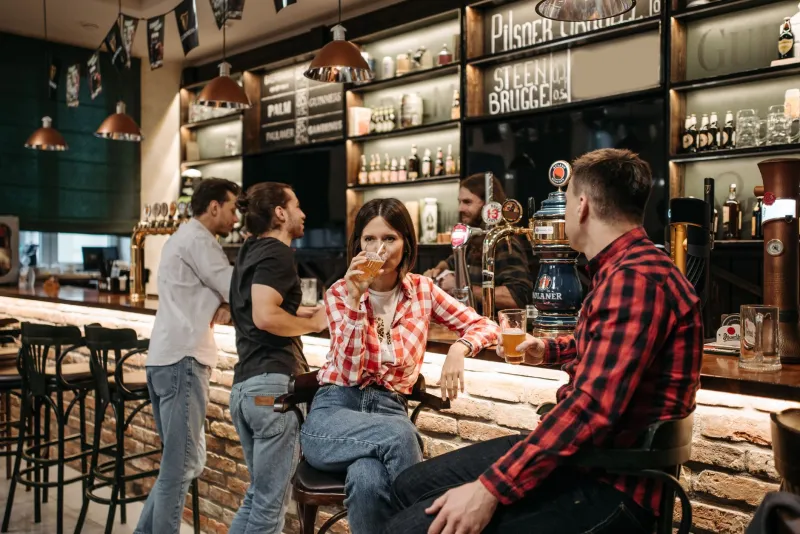
There's a guy at the end of the bar who's been coming in since the place opened. He knows the bartender's dog's name. He'll nod at you when you sit down — not because he knows you, but because that's just what you do here. Two booths over, a group of coworkers is unwinding from something that clearly went sideways today. At the shared table near the window, a couple of neighbors are arguing about the city council vote with the kind of passion that only exists when you actually care about where you live.
None of this was planned. None of it required an RSVP.
That's the magic of a third place done right. It creates the conditions for connection without forcing it. You can come alone and leave having talked to three people. You can come with friends and stay in your own bubble. The room holds both, and it doesn't judge either.
A familiar bartender is a bigger deal than it sounds. Knowing someone's name, remembering their usual, asking about the thing they mentioned last week — those small acts are social glue. They signal that you're known here, that your presence registered, that you're part of something even if you never signed up for it.
The Regular Is a Radical Act
Becoming a regular somewhere is one of the most underrated things you can do for your own wellbeing and your community's health. It sounds almost embarrassingly simple. But showing up consistently to a local spot is a form of civic investment that most people don't think about in those terms.
When you're a regular, you're doing a few things at once. You're keeping a small business alive with your dollars. You're creating the kind of ambient social density that makes a place feel worth visiting. You're building the kind of low-stakes familiarity with neighbors that, in a genuine emergency, actually matters. The people who checked on each other during the bad times? A lot of them met at the bar.
There's also something to be said for the way a good pub flattens social hierarchy in a way that few other spaces do. You're sitting next to a teacher, a plumber, a retiree, a grad student. The conversation can go anywhere. That kind of cross-section doesn't happen on your curated social media feed. It doesn't happen in the algorithm-sorted bubble of your streaming queue. It happens when people share physical space and a round of drinks.
Show Up Before It's Gone
Here's the honest part: third places don't survive on nostalgia. They survive on foot traffic. Every neighborhood pub that closes is a gap in the social map that almost never gets filled by something equivalent. A juice bar moves in. A nail salon. Something that's fine, but isn't a gathering place.
If you've got a local pub that feels like the real thing — where the bartender knows your name, where the food is made with some care, where people actually talk to each other — that place is fragile. It needs you to show up on the slow nights, not just the busy ones. It needs you to bring a friend who's new to the neighborhood. It needs you to let it be your third place instead of just a spot you hit when nothing else is going on.
Community doesn't maintain itself. It gets built in the small, repeated choices people make about where to spend their time and their money.
Your neighborhood pub is one of the last great rooms in America where that kind of community still gets made from scratch, every single night. Don't let it disappear while you're busy watching it happen on your phone.