Stop Sleeping on the Pub Burger: Why America's Bar Classic Is Actually a High-Wire Act
Stop Sleeping on the Pub Burger: Why America's Bar Classic Is Actually a High-Wire Act
There's a version of the pub burger that exists in every corner of this country, and most of us have eaten it without thinking twice. It arrives on a plate, maybe with a pickle spear and a pile of fries, and it does its job. You eat it. You move on. You couldn't describe it to someone the next morning if your life depended on it.
Then there's the other kind. The one that stops the table's conversation for a solid thirty seconds. The one that keeps regulars coming back on a Tuesday just to get their hands on it again. The one where, after the first bite, someone across the booth says, "Okay, yeah, that's a burger."
The gap between those two experiences isn't luck. It's craft. And for a dish this central to American pub culture, the pub burger deserves a lot more respect than it typically gets.
It Starts With the Beef — and the Ratio Matters More Than You Think
Let's get one thing out of the way: a good pub burger is not about exotic ingredients. It's not about wagyu imports or some boutique single-origin cattle operation. It's about understanding what ground beef actually does when heat hits it.
The fat content is where everything begins. An 80/20 lean-to-fat ratio is the gold standard for a reason — that 20 percent fat renders down during cooking, keeping the patty moist and giving it that rich, savory depth that a leaner grind simply can't replicate. Some kitchen teams push further and build a custom blend: brisket for flavor, chuck for structure, short rib for fat content and a bit of funk. That kind of intentionality shows up in the finished product in ways that are hard to articulate but impossible to miss.
Grind size matters too. A coarser grind creates a looser texture with more surface area to sear — which means more of that deeply browned, slightly crispy exterior that makes a smash-style burger so satisfying. A finer grind packs tighter and holds together better for a thicker patty. Neither is wrong. But choosing one without knowing why is where a lot of kitchens quietly lose the plot.
The Bun Is Doing More Work Than It Gets Credit For
Here's an unpopular opinion: a bad bun can ruin a great burger. And a great bun can quietly elevate a good one into something memorable.
The job of a burger bun is structural and sensory at the same time. It needs to hold together through the last bite without turning into a soggy, collapsing mess — but it also needs to have enough softness and give that it doesn't fight you on the way down. A brioche bun threads that needle well, with enough richness to complement the beef without overwhelming it. A toasted potato roll brings a pillowy softness that works beautifully with a smash-style patty.
What you want to avoid is a bun that's either too thick and bready (which throws off the beef-to-bread ratio and leaves you chewing through a mouthful of carbs) or too flimsy (which disintegrates halfway through and turns the whole experience into a structural emergency). Toast the cut sides on the flat-top. That small step creates a barrier that slows down soak-through and adds a layer of texture that makes a real difference.
The Case Against the Tower Burger
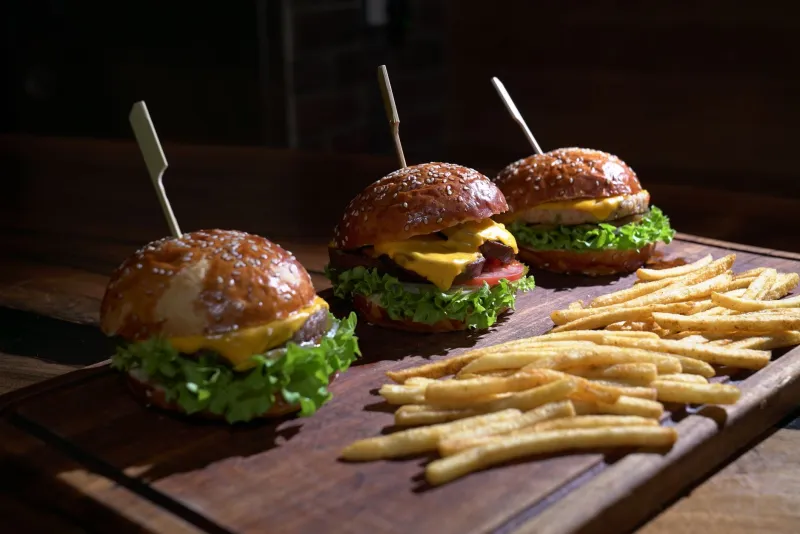
Somewhere along the way, the American restaurant industry decided that a burger needed to be impressive — and impressive got defined as tall. Towering stacks of ingredients. Three patties. Six toppings. A skewer holding the whole thing together because it would otherwise collapse under its own ambition.
This is, respectfully, the wrong direction.
The best pub burgers are restrained. They know what they are. A sharp cheddar or American cheese, melted properly — not just laid on top and barely warmed, but actually melted into the patty, sealed against it with a dome and a splash of water if you're doing it right. Shredded iceberg or butter lettuce for crunch and temperature contrast. A thin smear of a well-seasoned house sauce. Maybe some caramelized onions if the kitchen has the patience to actually caramelize them (low heat, forty-five minutes, not the pale steamed version that gets passed off as the real thing).
Every topping should earn its place by making the burger taste more like itself, not by distracting from it. When you're stacking avocado, fried egg, pulled pork, and three sauces onto a single patty, you're not building a better burger — you're building a conversation piece that happens to have beef somewhere in the middle.
Temperature, Timing, and the Sins of the Well-Done Default
A pub burger cooked to medium — pink in the center, juicy through the whole patty — is a fundamentally different experience from one cooked through. The proteins tighten differently. The fat renders differently. The texture changes in ways that no amount of sauce can compensate for.
Now, there are real food safety considerations with ground beef that don't apply to a whole steak, and every kitchen has to navigate those honestly. But a kitchen that defaults to well-done on every burger without asking, or that flinches when someone asks for a little pink, is leaving a lot of quality on the table.
The ideal pub burger is cooked with attention. Someone is watching it. They know when to flip it (once, not repeatedly), when to add the cheese, and when to pull it off before carryover cooking finishes the job. These are small things that take almost no extra time — but they separate kitchens that care from kitchens that are just moving product.
What to Look for When You Sit Down
You don't need to interrogate the server or send a burger back on principle. But if you want to find your local spot's best burger — or figure out whether the one you've been ordering is actually as good as it could be — here's a quick mental checklist:
- Does the bun look toasted? Cut sides should have some color on them.
- Is the cheese actually melted? Not just placed, but fused to the patty.
- Is there visible juice when you press it lightly? A good patty holds moisture.
- Are the toppings proportional? Nothing should be fighting for dominance.
- Does it hold together through the last bite? Structural integrity is a feature, not a bonus.
If the answer to most of those is yes, you've found a kitchen that takes the burger seriously. Tip accordingly.
The Pub Burger as a Statement of Intent
At Eagle Rock, we think a lot about what it means to do simple things well. A cold pint poured right. A room that feels like it's been there a while. Food that you actually want to eat, not just photograph.
The pub burger fits all of that. It's not flashy. It doesn't need a three-paragraph menu description or a backstory about the farmer. It just needs to be executed with care, served hot, and eaten with both hands. When a kitchen gets that right, it becomes the dish people bring their friends back for — the thing that turns a first visit into a regular habit.
And honestly? That's the whole point.