The Basket Mentality: Why Pub Sides and Shareable Bites Are the Real Stars of the Table
There's a moment that happens at almost every great pub night. Someone orders a round, someone else scans the menu, and then — almost always — someone says it: "Should we get wings?" And just like that, the table comes alive. Not because of the entrées. Not because of the cocktail list. Because of a basket.
Pub sides and shareable bites occupy a strange, underappreciated corner of American dining. They're not the headliners. They don't get the Instagram treatment. They're rarely what a restaurant leads with in its marketing. But they are, almost without exception, the thing people remember most fondly when they talk about a great night out. The sticky fingers. The argument over the last ring. The way a fresh basket hits the table right as the second round arrives.
That's not an accident. That's culture.
What We Actually Mean When We Say "Pub Sides"
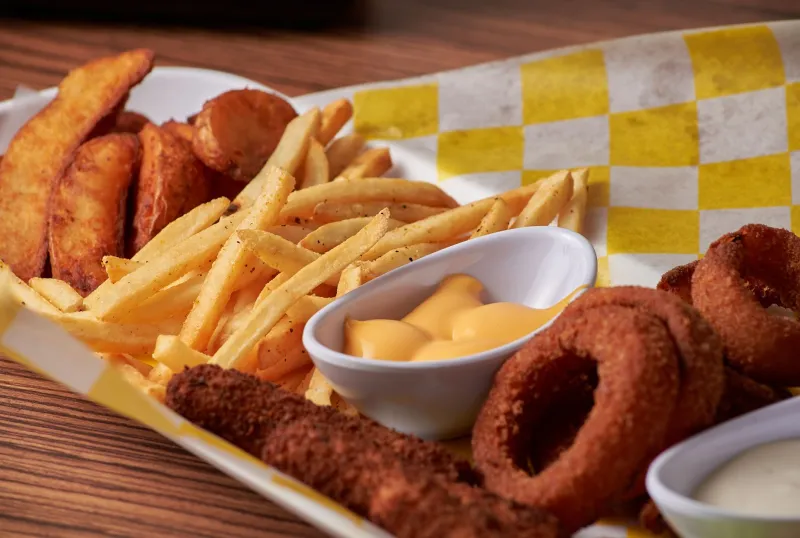
Let's be specific, because this category is broader than it sounds. We're talking about onion rings with a shatter-crisp batter. We're talking about wings — bone-in, sauced properly, served hot enough to make you wait a beat before you commit. We're talking about mozzarella sticks that stretch the way they're supposed to, loaded potato skins with enough toppings to constitute a meal, fried pickles that hit that perfect sour-salty note, and soft pretzel bites that disappear faster than anyone planned.
These aren't afterthoughts. They're the connective tissue of a pub meal — the shared experience that turns a group of people sitting near each other into an actual table.
The Onion Ring Problem (And How to Solve It)
Here's the thing about onion rings: almost everyone serves them. Almost nobody gets them right.
The failure points are specific. Too thick a batter and you lose the onion — you're just eating fried dough with a vague sweetness in the middle. Too thin and the whole thing collapses on the first bite, the onion sliding out in one slippery ring that lands on your shirt. The sweet spot is a batter that clings, that has enough body to hold its structure but enough crispness to give you that audible crack when you bite through.
Seasoning matters more than people admit. A little smoked paprika in the dredge. Some garlic powder. Maybe a touch of cayenne if you want heat without announcing it. The onion itself should be sweet — Vidalia or a similar variety — so there's contrast between the savory crust and what's inside. And they need to be served immediately. Onion rings are one of the most temperature-sensitive things in a pub kitchen. A two-minute delay is the difference between a great ring and a sad, soggy one.
A dipping sauce matters too, but it shouldn't be doing the heavy lifting. If your rings need a complex aioli to taste good, the rings aren't good enough.
Wings: The High-Wire Act Nobody Talks About
Wings have become so ubiquitous in American bar culture that it's easy to forget they're actually difficult to execute well. The margin between a transcendent wing and a mediocre one is surprisingly thin.
The first question is always the cook. A wing needs to render its fat properly — which means time, either in a low-temp fry or a two-stage cook that finishes at higher heat. Rushing this step gives you a wing with rubbery skin, which is the cardinal sin. The skin should be tight, a little blistered in spots, with a crispness that holds even after it's been tossed in sauce.
Speaking of sauce: the ratio matters enormously. A wing drowning in sauce is a wing that's been disrespected. You want enough to coat every surface, enough that it's the first thing you taste, but not so much that the texture you worked to build has been steam-softened into mush. Toss them in the sauce hot, right before they hit the table, and serve them fast.
The flavor range matters too. A pub that only offers buffalo and honey garlic isn't taking wings seriously. The classics deserve to be there, but a properly constructed dry rub option — something with brown sugar, chili, and a hit of cumin — gives the table a reason to order two baskets instead of one.
The Social Architecture of a Shared Basket
There's something worth naming here that goes beyond technique and seasoning. Pub sides are fundamentally communal in a way that most food isn't.
When you order an entrée, it's yours. You might share a bite, but the plate belongs to you. When a basket of wings hits the center of the table, the whole dynamic shifts. There's negotiation. There's generosity. There's the unspoken awareness of who's been holding back and who's gone in for a third one. There's the moment when someone pivots the basket toward a friend who hasn't grabbed one yet.
This is not a small thing. In a culture where so much of our social interaction has moved to screens, the act of passing a basket around a table — of literally reaching across to offer someone a bite — is one of the more genuinely human things that still happens regularly in American life. Pub food facilitates that. The format demands it.
A plate of apps you're meant to share alone doesn't have the same energy as a basket. The basket implies abundance. It implies take what you want, there's enough. That's a particular kind of hospitality, and it's one that great pubs understand intuitively.
The Ones That Don't Get Enough Credit
While wings and rings carry most of the conversation, there's a supporting cast worth championing.
Loaded potato skins — done properly, with the potato scraped thin and crisped in the oven before it's topped — are legitimately great pub food. They've been dismissed as a relic of chain restaurant menus, but a well-executed skin with sharp cheddar, real bacon, and a cold dollop of sour cream is hard to argue with.
Fried pickles are having a moment nationally, and they deserve it. The acidity of a dill pickle slice against a seasoned cornmeal crust is a flavor combination that makes more sense than it has any right to.
Soft pretzels, especially when they're baked fresh rather than frozen and reheated, pair with a cold pint in a way that feels almost engineered. The chew, the salt, the slight bitterness of the beer — it's one of the more reliable small pleasures available at your neighborhood pub.
Why This All Matters
It would be easy to write off pub sides as simple food for simple occasions. But that framing misses the point entirely. The best versions of these dishes require real skill, real attention, and a genuine respect for what they're supposed to do — which is bring people together, lower the temperature of a room, and give everyone at the table something to reach for.
At Eagle Rock, we think about this a lot. A cold pint is better with something worth eating. Good company is better with a reason to linger. And a basket of properly made wings, passed around a table of people who are genuinely glad to be there, is about as good as a Tuesday night gets.
So next time you're scanning the menu, give the sides their moment. Order the rings. Get the wings. Let someone else grab the last one.
That's the whole point.