Why Your Beer Tastes Better at Some Bars Than Others — And Exactly What to Look For
You've had the experience. You order the same beer at two different bars, and somehow — inexplicably — it tastes completely different. One is crisp, balanced, alive. The other is flat, weirdly warm, or tastes like it came out of a garden hose. Same brewery. Same style. Completely different result.
This isn't a mystery. It's craft, or the lack of it. And once you understand the three variables that make or break a pint — temperature, glassware, and pour — you'll never look at a bar menu the same way again.
Don't worry, this isn't going to get snobby. Knowing this stuff makes drinking more fun, not more stressful.
Temperature: The Most Underrated Variable
Let's start with the thing most bars get wrong most consistently: serving temperature.
American drinking culture has long operated under the assumption that colder is better. Ice-cold beer, frosty mugs, pitchers practically frozen. For certain styles, that's completely fine. A light lager on a hot summer afternoon? Yeah, serve it cold. But blanket-freezing every style of beer is like serving all wine straight from the refrigerator — technically possible, but you're murdering the flavor.
Here's a loose guide to where different styles actually want to land:
- Light lagers and American adjunct beers: 35–40°F. These are genuinely better cold. The style is built for it.
- Wheat beers and hefeweizens: 40–45°F. A little warmer lets the banana and clove notes breathe.
- Pale ales and IPAs: 45–50°F. Hop aroma opens up dramatically when the beer isn't freezing. A too-cold IPA tastes bitter and flat. A properly temped one is fragrant and layered.
- Stouts and porters: 50–55°F. This is where most American bars fall way short. A stout served at 38°F is a shadow of itself. Warm it up just a few degrees and suddenly the chocolate, coffee, and roasted malt flavors come forward in a way that feels almost revelatory.
- Belgian ales and barleywines: 55–60°F. These are complex, high-ABV beers that deserve a little warmth to show their full range.
A bar that understands this will often serve different styles at intentionally different temperatures. That's a green flag.
Glassware: Not Just an Aesthetic Choice
Here's where it gets genuinely interesting. The shape of a glass isn't just about looking nice on Instagram — it actively changes how a beer tastes and smells.
The science is straightforward: glassware affects how volatiles (the aromatic compounds in beer) are released, how much head forms and stays, and how quickly the beer warms in your hand. Different shapes serve different purposes.
Shaker pint glasses — those thick, straight-sided glasses you see everywhere — are fine for basic serving, easy to stack, and cheap. They're also the worst possible vessel for most craft beers. They trap almost no aroma, encourage the head to dissipate quickly, and are wide enough that your hand warms the beer fast. They're the sweatpants of glassware: practical, but not exactly trying.
Tulip glasses have that slightly flared lip and curved body for a reason. The shape concentrates aroma toward your nose as you drink, and the flare helps maintain a proper head. IPAs, saisons, and Belgian ales genuinely show better in a tulip. This isn't beer snobbery — it's physics.
Weizen glasses (the tall, curvy ones) are designed for wheat beers. The extra volume at the top allows the thick, pillowy head that a hefeweizen is supposed to have. Pouring a hefeweizen into a shaker pint is a small crime.
Snifters and goblets work for high-ABV, aromatic beers — barleywines, imperial stouts, Belgian quads. The wide bowl lets you actually swirl and nose the beer the way you would a whiskey or wine.
Pilsner glasses — tall, tapered, and elegant — are designed to show off a lager's clarity and carbonation while keeping it cold longer. They look great for a reason.
A bar that matches glassware to the style being served is a bar that's paying attention.
The Pour: Where Technique Actually Matters
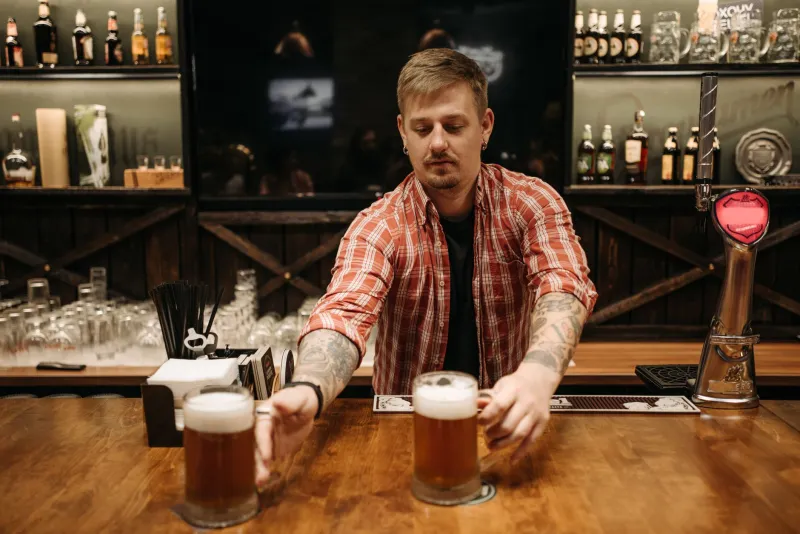
A proper pour is the final step, and it's more nuanced than it looks.
The biggest mistake bartenders make is pouring straight down the center of the glass, resulting in either a massive foam overflow or — if they compensate by tilting the glass too aggressively — almost no head at all. Both are wrong.
Here's what a good pour looks like:
- Start with a clean, room-temperature glass (not a frozen mug — more on that in a second). Residual soap film or freezer frost will destroy carbonation and kill the head almost instantly.
- Tilt the glass at roughly 45 degrees and begin pouring against the side, not the bottom. This controls foam production.
- Straighten the glass gradually as it fills, finishing with the glass upright for the last inch or two. This generates the head intentionally.
- Aim for about an inch to an inch and a half of head on most styles. The head isn't wasted beer — it's aroma delivery. A beer with no head is a beer with muted flavor.
Now, about those frozen mugs. They look refreshing, and for a mass-market lager they're fine. But for any beer with real flavor complexity, frosted glassware is actively harmful. The ice-cold surface kills carbonation on contact and suppresses aroma. A bar that serves a craft IPA or a stout in a frozen mug either doesn't know better or doesn't care — neither is great.
The Quick Checklist: How to Judge Any Bar's Pint Game
Next time you walk into a new pub, run through this before you order your second round:
- Does the bar stock multiple glass styles? Variety is a good sign.
- Is your IPA or stout served at a slightly warmer temp than a lager would be? Ask if you're not sure — a good bartender will know.
- Is there a proper head on your beer? About an inch is the sweet spot for most styles.
- Does the glass look clean and dry (not frosted)? Frost on a craft beer glass is a red flag.
- Can you actually smell the beer before you drink it? Aroma is flavor. If you get nothing, something went wrong upstream.
- Does the bartender seem to know what they're serving? Passion and knowledge are contagious. A staff that cares about beer will pour better beer.
You don't need to interrogate anyone. Most of these you can figure out just by watching and sipping.
What We Believe at Eagle Rock Public House
Here, we take the pint seriously — not because we want to lecture anyone, but because we genuinely believe a well-poured beer in the right glass at the right temperature is one of life's small, reliable pleasures. It's not complicated. It just takes a little care.
Good company, cold (or appropriately tempered) pints, and food worth talking about — that's the whole idea. Now that you know what to look for, we hope every pint you drink from here on out is a little more satisfying.
Cheers.